

Debased Rates: How Infrastructure Trackers Thwart Regulatory Scrutiny
By Jamie Van Nostrand, Policy Director

In my first Based Rates post, I explained how rate-of-return regulation gives gas utilities a powerful incentive to invest in capital projects, particularly pipe replacement, and why rigorous regulatory scrutiny is the necessary check on that behavior. In my most recent post, I described how the Illinois Commerce Commission, aided by expert intervenors, did an excellent job scrutinizing the excessive capital spending of two of its gas utilities, saving customers hundreds of millions of dollars.
In the Illinois proceeding, the issue was addressed as part of general rate cases, which gave the regulators and the parties an opportunity to take a deep dive on infrastructure spending. In most states, however, pipeline replacement costs are recovered in rates through a dedicated infrastructure tracker, a mechanism that allows utilities to recover specified costs outside of a rate case.
This post is about how those trackers have quietly displaced traditional ratemaking in state after state, enabling utilities to largely evade regulatory scrutiny and boost capital expenditures.
Tracking Mechanisms versus Traditional Ratemaking Treatment
Tracking mechanisms, or reconciling mechanisms, provide preferential treatment for recovering certain expenditures through your utility bill. The essential elements are (1) dollar-for-dollar recovery of covered expenditures, (2) elimination of the delay between incurring the costs and recovering the costs in rates, (3) examination through an expedited review process, and (4) itemization of a rate recovery surcharge on your utility bill. Each of these elements is a departure from how costs incurred by LDCs are typically handled by state regulators.
In the absence of a tracking mechanism, an LDC would typically recover costs associated with addressing aging gas infrastructure through base rates, which are determined through general rate cases filed with state regulators. General rate filings are lengthy proceedings – depending upon the state, it can take up to eleven months from initial application to final decision – involving expert testimony (by the LDC as well as consumer advocates and other intervenors), extensive discovery, and trial-type formal evidentiary hearings.
The LDC has the burden of demonstrating the prudence of its infrastructure spending, the level of which is determined based on historical cost levels and projections of future spending, with a goal of including in base rates a representative level of costs. The amounts ultimately determined for recovery in rates are estimates – if the LDC spends more or less, rates are not adjusted to reflect the actual level of spending. And there is a delay – commonly referred to as “regulatory lag” – between the time the LDC spends the money (in a historical period preceding the rate filing) versus when it recovers the costs in rates (the future period after new rates take effect). This lag provides an incentive for the LDC to control costs (i.e., pursuing the lowest cost method to remediate aging pipes, such as repair or relining, rather than simply replacing them).
In the case of a tracking mechanism, this regulatory lag is eliminated – rates are approved that provide for the immediate recovery of projected spending levels. And rather than relying upon estimated spending levels, actual spending versus projected spending is reconciled to provide for dollar-for-dollar recovery. (That line item on your gas bill for infrastructure cost recovery ensures that the LDC recovers every dollar that it spends on the approved program.) Finally, the review process is expedited; as compared with the extended hearing process for general rate cases, filings for tracking mechanisms are reviewed in a much shorter period – in some states, as short as thirty days – thereby depriving consumer advocates and other intervenors of a meaningful opportunity to review and challenge these expenditures.
The Policy Basis for Tracking Mechanisms
Legislators and regulators can decide as a matter of policy that certain expenses can be handled through expedited cost recovery mechanisms rather than being reviewed through the traditional ratemaking process. These trackers have their origins in fuel adjustment clauses for electric utilities, most notably from the experience of Con Edison in 1973 when it missed a quarterly dividend as fuel oil costs surged in response to the first Arab oil embargo and it was unable to recover the higher costs in rates expeditiously.
At the outset, trackers were typically limited to cost categories (1) representing a material portion of the utility’s overall costs that are (2) volatile and (3) outside the utility’s control. Over time, however, the use of reconciling mechanisms providing for prompt dollar-for-dollar recovery has been expanded to any number of initiatives determined by state legislatures or regulators to be justified as a matter of public policy, such as for energy efficiency and decarbonization programs, procurement of clean energy resources, or environmental remediation programs.
The Rapid Expansion of Trackers for Gas Infrastructure Spending
LDCs began to recover pipe replacement costs through infrastructure trackers on a large scale in the early 2010s. The proliferation of infrastructure trackers was not organic. Rather, it was actively encouraged by the federal government. Following several high-profile pipeline accidents, including the September 2010 explosion in San Bruno, California, DOT Secretary Ray LaHood issued a “Call to Action” urging states to create programs to accelerate pipeline replacement, with then PHMSA Administrator Cynthia Quarterman following up directly to state regulators urging the adoption of expedited rate recovery mechanisms. The pitch was framed as a safety imperative. States responded, and by the early 2010s roughly 40 had trackers in place.
The safety outcomes, measured against that stated purpose, have been disappointing. Gas distribution capital expenditures have more than quadrupled since the Call to Action, from less than $6 billion in 2010, to over $28 billion in 2023, yet PHMSA incident data shows no statistically significant improvement in system safety over the same period.
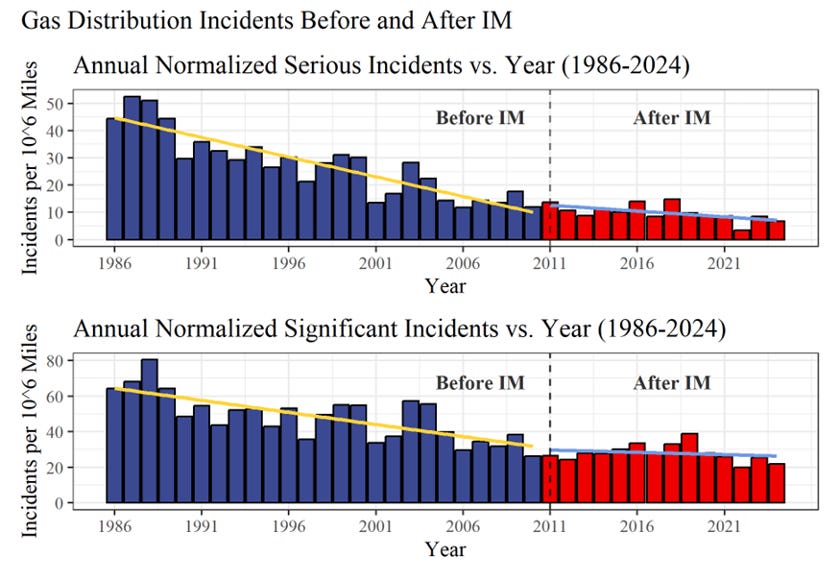
Source: Analysis of PHMSA gas distribution incident data (1986–2024), normalized to miles of pipe. Future of Heat Initiative, forthcoming.
The yellow trendline in the chart shows that gas system safety was steadily improving before trackers proliferated. The blue trendline shows that improvement did not accelerate afterward. Trackers boosted capital spending without delivering the safety outcomes used to justify them.
The Effort to Break STRIDE in Maryland
The experience in Maryland, where legislators held hearings this week to re-examine the existing cost recovery mechanism, illustrates how utility customers have borne the consequences of the abuse of cost recovery trackers by LDCs.
Maryland’s gas infrastructure tracker, the Strategic Infrastructure Development and Enhancement Plan (STRIDE), was adopted in 2013. The legislature is currently considering a bill, HB1253, the Break STRIDE Act, that would repeal the current infrastructure tracking mechanism and associated surcharge. Going forward, rate recovery of expenditures to remediate aging pipe would revert to general rate cases, where the LDC would have to demonstrate the prudence of the expenditures.
Our Maryland Gas Affordability Primer exposes the consequences for Maryland residential customers of having STRIDE in place for the past 10+ years. Taking advantage of the preferential rate treatment provided by STRIDE, Maryland’s gas utilities have invested billions to excavate and replace old pipelines, more than doubling the gas assets upon which they earn a return – from $3.4 billion to over $8 billion. As a result, even though typical residential customers in Maryland use 26% less gas today compared to 2014, their bills have increased by about 6% per year over the last five years. And customers are paying more for pipes (delivery) than for the gas itself – 62% of a residential customer’s bill is for delivery, while 38% is for the gas itself, which is a complete reversal from the proportions in 1984.
Maryland is Not Alone
Nationwide, gas delivery rates across the country have nearly doubled since 2011, increasing at more than twice the rate of inflation. This expansion has been facilitated – and in fact incentivized – by the existence of infrastructure tracking mechanisms in place throughout the U.S., and LDCs’ exploitation of these mechanisms. Infrastructure trackers for gas companies should be phased out and ultimately eliminated, in favor of cost recovery through the traditional ratemaking process. That process, among other things, enables a more comprehensive review of infrastructure spending and restores the necessary incentive to control costs provided by regulatory lag. The best way to eliminate the exploitation of infrastructure trackers by gas companies is simply to abolish them.